A lot of terms get thrown around when you start working out. Sometimes it can get confusing. Use the glossary below to learn some basic (and not so basic) terms you’ll hear across this site and across the gym.
Rep? Set? Plyometric?
What does any of this mean?
- Rep – One repetition of an exercise
- Half-Rep – Only performing half of the Range of Motion of a given exercise, common in sports based lifting
- AMRAP (As Many Reps As Possible) – As Many Reps as possible, until failure.
- MYO Rep – Light weight reps (40-50% 1RM) to failure, then 5-10 seconds of rest followed by 3-5 more reps, repeating the rest/rep cycle until failure.
- Set – A group of a specific number of repetitions of an exercise, followed by rest. Example: “3 sets of 8 reps is generally good advice for most gym-goers”.
- Burnout Set – A set of an exercise designed to be done at the end of that particular movement, which is done until failure with the goal being to ‘burn out’ your muscle tissue.
- Drop Set – A set which starts heavy and decreases as you go. The idea being you’re strongest pre-fatigue, so your first set (after warmup) should be your strongest
- Pyramid Set – A set which starts light, and increases in weight to a peak, then decreases back to (or below) the starting weight. If graphed it will look like a pyramid.
- EMOM (Every Minute on the Minute) – A term used to time an exercise. Usually requiring a set of a specific group of exercises done within that interval.
- SuperSet – Performing one exercise while you are resting from another. Usually performed with non-antagonistic exercises. For example, if you do bicep curls in-between dumbbell pull-overs you would be performing a good superset. As biceps are not a primary muscle in dumbbell pull-overs.
- Compound Lift – A lift, usually performed near the beginning of a workout, which works multiple muscle groups. RDL’s, for example, work your entire posterior chain. An incline bench press works front-deltoids, side-deltoids, chest, and, triceps.
- Active Recovery – A recovery period, usually a few days, where you do not stop working out, but instead lift at 30-50% of your normal weight.
- Anabolic – The metabolic processes inside your body that build muscle.
- Anaerobic – Exercise that uses glucose instead of oxygen to produce energy. Weightlifting is a good example.
- Aerobic – Exercise that uses oxygen instead of glucose to produce energy. Walking/Jogging is a good example.
- BPM (Beats Per-Minute) – How many times in a given minute your heart beats. There are different zones dependent on age and fitness where you want to stay.
- BMR (Base Metabolic Rate) – How many calories you can consume without gaining or losing weight
- BMI (Body Mass Index) – A bad metric, created by insurance companies in the 50’s, designed to quickly calculate overall fitness. This is outdated, and is not useful.
- Concentric – The part of an exercise where a muscle flexes and shortens. When pushing a barbell up, the chest contracts, this is the concentric part of the movement.
- Eccentric – The part of an exercise where a muscle lengthens and expands. When lowering a barbell to your chest, the chest expands, this is the eccentric part of the movement.
- Plyometric – Training which uses high-impact movements designed to improve power and speed. Usually associated with sports.
- Isometric – Holding a static position to build strength and endurance. When you have the barbell out in front of you during a bench press, just holding it is it’s own form of exercise.
- Catabolic – Metabolic process inside your body that breaks down fat and muscle.
- Cooldown – Low intensity exercise, usually at the end of a workout, which is meant to lower the heart rate.
- DOMS (Delayed Onset Muscle Soreness) – Soreness that occurs more than a day after the workout. Often associated with leg workouts.
- Form – The overall technique of an exercise.
- Functional Fitness – Fitness designed to make everyday tasks easier.
- Plateau – A point at which you have stalled, usually discussed as lifting progress. “I was making gains for a few months, but I plateaued at 185 on squats”.
- Rest Day – No idea, ask your mom.
- RPE (Rate of Perceived Exertion) – A 1-10 scale designed to measure how difficult an exercise is to a specific person.
- ROM (Range of Motion) – How far a joint moves during an exercise. Generally speaking – better (larger) ranges of motion create more resilient joints.
- Spot – Assisting someone else’s lift by providing support and safety in case they fail.
- Tempo – The rate at which someone performs a given exercise
- VO2 Max – Maximum oxygen consumption, how much o2 your body can use during a workout.
- Volume – Usually used when referring to the amount of reps or sets you do during a given workout.
- Barbell – Long bar, designed to hold plates. Usually weighs 45 lbs, but there are exceptions. There are different types of bars, act accordingly.
- Dumbbell – A pre-measured weight, usually stored in racks along a gym wall. Often can be used to do the same or similar exercises with a barbell, but allows you to isolate different sides of your body.
- Isolation – Limiting an exercise to a specific muscular region, or specific muscle group.
- Collar/Clip – Used to keep weights from sliding off of a Barbell
- Free Weights – Any weights not attached to a machine, which may be freely moved around the gym area.
- Kettlebell – A weight shaped like a cannonball with a handle.
- Medicine Ball – A soft, but heavy, ball used for plyometric exercise
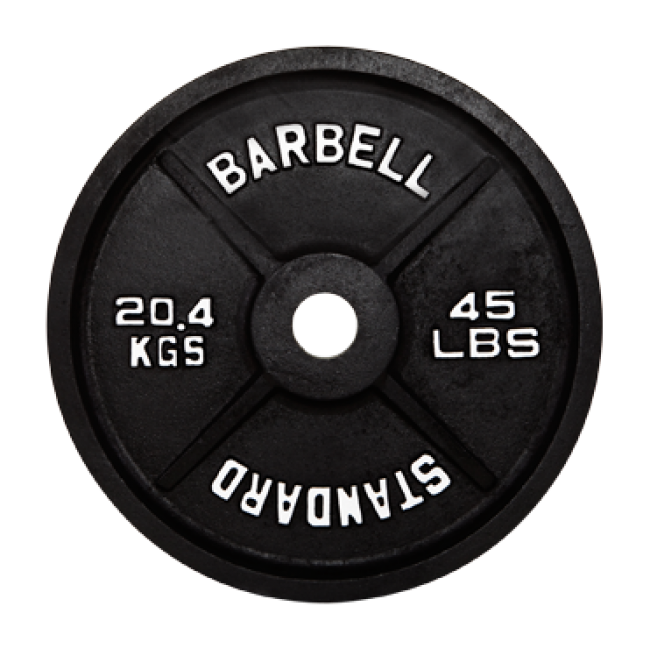
- Plate/Buck/Wheel/Cookie/PR Plate – A weight designed to be used with a barbell
- Plate/Buck/Wheel all usually reference a 45 lb weight.
- Cookie/PR Plate usually reference a 2.5lb weight.
- Smith Machine – A barbell on tracks, with many safety stops that can be engaged by rotating the bar. Often a safer alternative when doing barbell work alone and with no spotter.
- Cardio – Exercise that engages the heart, usually aerobic in nature.
- Circuit – An exercising style which involves moving from one exercise to the next with small rest intervals.
- HIIT (High Intensity Interval Training) – AN exercise style that involves very high intensity work, followed by brief periods of rest.
- Mesocycle – A training block of 4-8 weeks within a given training plan (macrocycle)
- Macrocycle – A full length training plan, usually associated with a competition, or show.
- Progressive Overload – Gradually increasing weight or intensity of an exercise.
- Static Stretching – Stretching which places a joint in a fixed position for a period of time.
- Warm-up – Usually a very light-weight version of an exercise which is designed to get blood flowing in muscle tissue and stretch your joints.
- Dynamic Stretching – Like Yoga or Pilates, stretching which takes your joints through a range of motion.
- Pin – Typically, the small piece of metal which holds weights within a stack on a machine.
- Less typically, the act of injecting a substance, usually peptides or steroids.
- Gains – Muscle growth as a result of diet and/or exercise
- Pump – The short-term effect after working out where your muscle tissues are still flushed with blood. Often comes with the result of looking more muscular, but can sometimes also make you look bloated.
- PR (Personal Record) – Your current best, heaviest weight, or highest number of reps, for a given exercise.
- Bulk – Intentionally consuming more calories than you expend with the goal of gaining muscle or size. It is generally quite easy to feel strong during a bulking phase.
- Cut – Intentionally consuming fewer calories than you expend with the goal of losing fat or size. It is generally common to feel weaker during a bulking phase.
- Macro – 3 major nutrient targets for energy: fat, protein, carbohydrates. Each is important and should not be ignored.